
From Modern Expressionism to Afrofuturism and Afrosurrealism, artists are using the machine to examine power, identity, and the possibilities of the future.
The robot has long occupied a contradictory place in the cultural imagination. It is both a promise and a warning: a symbol of innovation and progress, but also of labor displacement, surveillance, and systems beyond human control. In contemporary Black art, however, the machine takes on another role—not as a replacement for humanity, but as a way of investigating what it means to be human.
Across painting, digital media, and speculative imagery, artists are taking on the robot as a vehicle for memory, critique, and imagination. Rather than depicting technology as a distant futuristic force, these artists explore how technology is already embedded within histories of race, labor, culture, and identity.
The presence of robotic imagery in Black contemporary art connects to several overlapping movements, including Modern Expressionism, Afrofuturism, and Afrosurrealism. In the hands of Black artists, the robot can signal technological empowerment, cultural resilience, surveillance, displacement, or dystopian collapse. Its meaning is never fixed. It shifts with the questions each artist asks about humanity itself.
The Machine as System: Marcus Jansen and Modern Urban Expressionism
Marcus Jansen approaches the machine through the lens of social structures. His paintings, rooted in Modern Urban Expressionism, combine graffiti, abstraction, and figurative distortion to examine the psychological landscape of contemporary society.
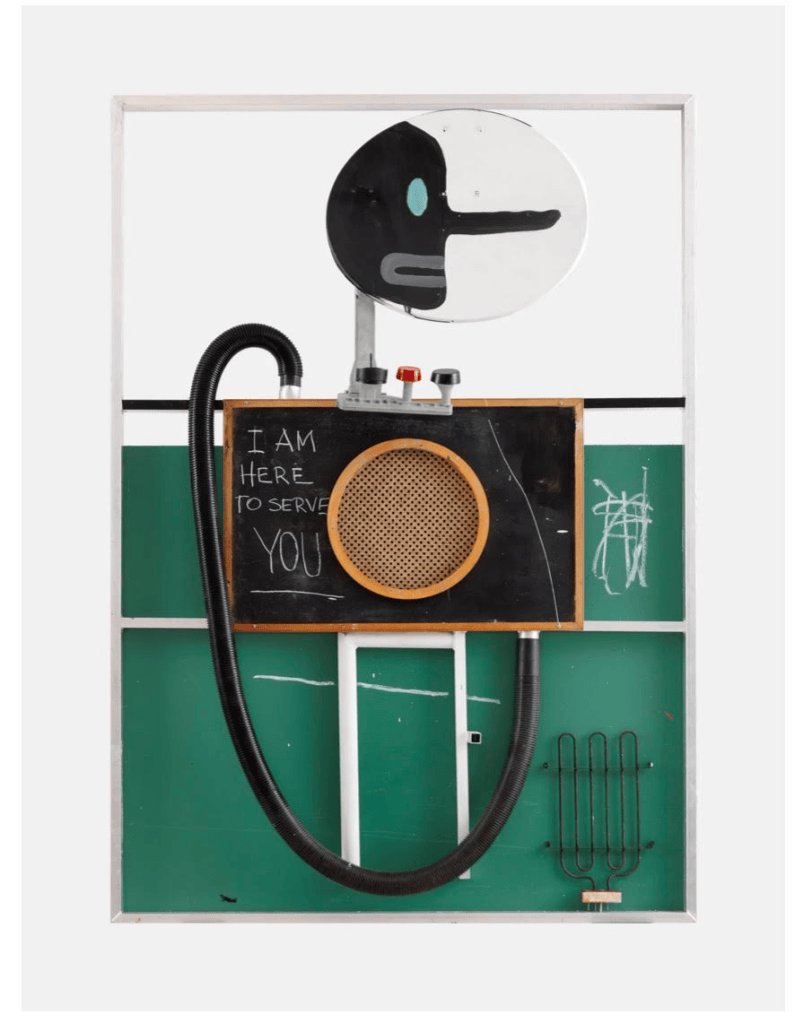
The movement reflects the tensions of modern urban life—the collision of industrialization, political instability, economic inequality, and cultural transformation. In Jansen’s work, the city becomes a psychological space where history and the present collapse into one another.
Born in Manhattan’s East Harlem in 1968 and shaped by experiences in both New York and Germany, Jansen developed an artistic language informed by displacement, racism, military experience, and the contradictions of global systems. His paintings frequently address colonialism, capitalism, gentrification, and the invisible forces that shape everyday life.
His machine imagery extends this investigation. In works from his Man and Machine series, technology becomes a continuation of the systems humans create—raising questions about whether technological progress will challenge existing power structures or reinforce them.
For Jansen, the machine is not futuristic fantasy. It is evidence of the systems already operating around us.
The Machine as Self: Jasimen Phillips and Afrofuturist Portraiture
If Jansen examines the external systems that shape humanity, Jasimen Phillips turns toward the internal relationship between technology and identity.
Phillips’ work is rooted in Afrofuturism, a movement that has long explored the intersection of Black history, science fiction, technology, and imagined futures. Evolving through the work of artists, writers, and musicians who questioned whose futures are represented, Afrofuturism uses speculative worlds to rethink narratives of possibility.
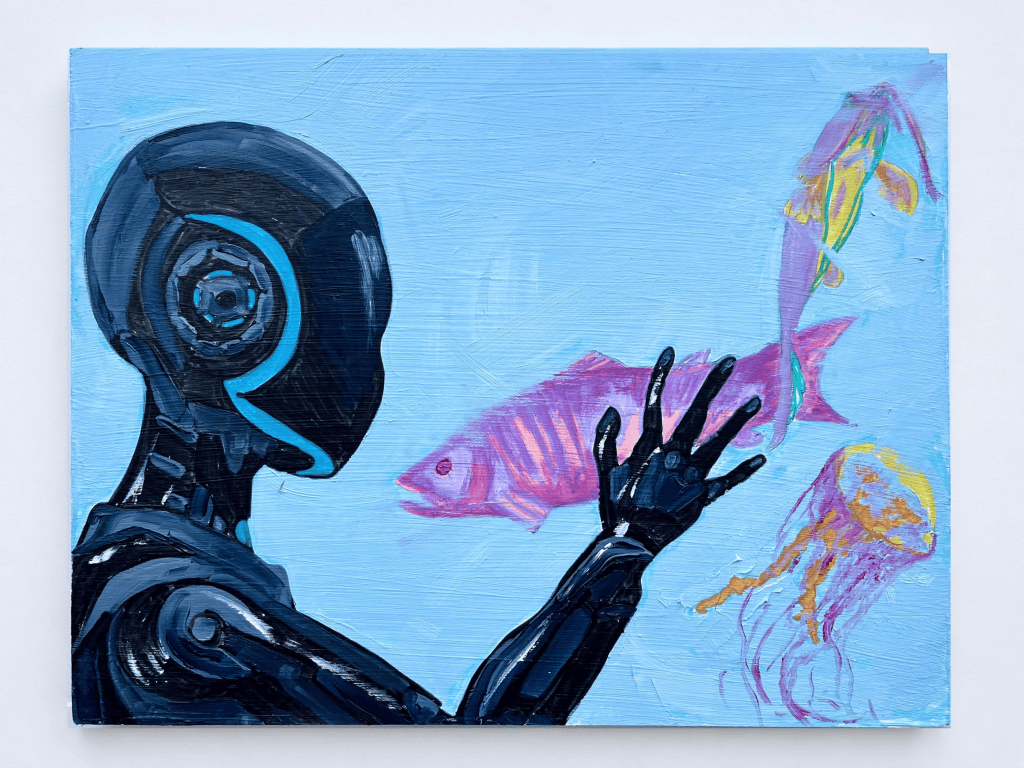
Phillips expands this tradition through figurative painting, creating expressive robot portraits that merge technological imagery with the conventions of historical portraiture. Her machines are not anonymous devices; they possess emotion, personality, and cultural memory.
Through texture play, bold color, and expressive mark-making, Phillips examines technology as something deeply connected to human experience. Her paintings ask what happens when machines reflect the emotions, histories, and identities of the people who create them.
In her work, the robot becomes a new form of portraiture—a way to examine humanity at a moment when the boundaries between biological and technological life are increasingly blurred.
The Machine as Myth: Vince Fraser and Afrosurrealism
While Jansen uses technology to investigate systems and Phillips uses it to explore identity, Vince Fraser transforms technology into a space of mythmaking.
Fraser’s work is connected to Afrosurrealism, a movement that combines Black cultural history, ancestry, spirituality, and dream logic to create alternate realities. Rather than separating the futuristic from the ancestral, Afrosurrealist practices often imagine time as layered—where memory, history, and possibility coexist.
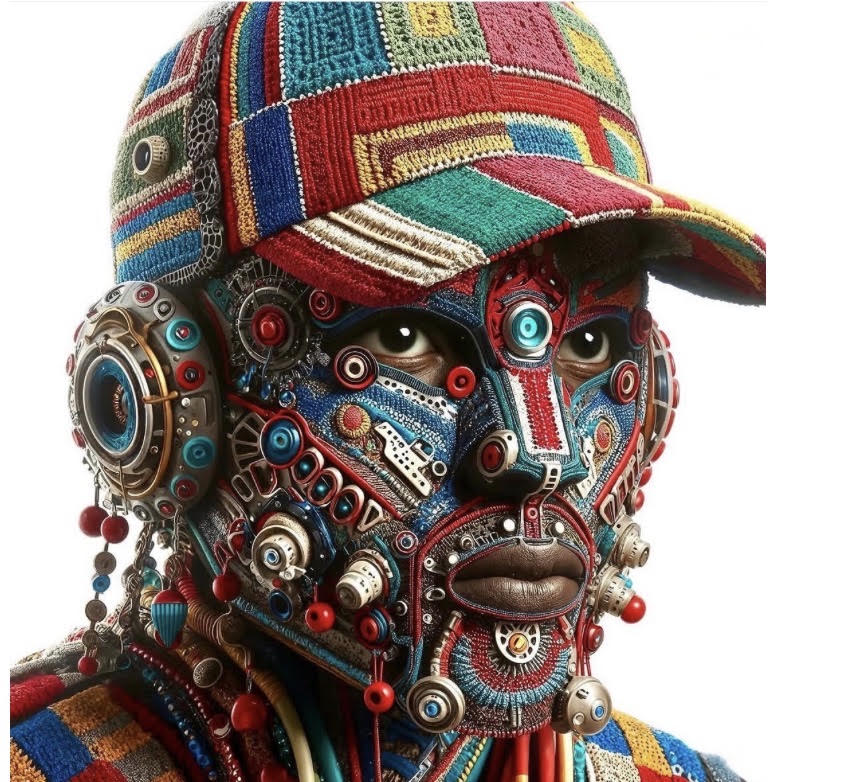
Working through digital art, 3D design, motion graphics, and AI-influenced imagery, Fraser creates cinematic environments where technology becomes a tool for cultural storytelling. His work draws from his Jamaican heritage and broader African diasporic narratives, positioning digital innovation as a continuation of ancestral creativity.
In Fraser’s imagined worlds, technology is not a departure from history. It is another language through which history can survive, transform, and expand.
Beyond the Binary of Human and Machine
The growing presence of robots in Black contemporary art is not evidence of a passing aesthetic trend. It reflects a broader cultural shift in how artists are grappling with technology’s expanding role in everyday life. As artificial intelligence, automation, and digital systems increasingly shape our relationships, labor, memory, and identities, the robot has become one of contemporary art’s most potent metaphors—not for machines alone, but for humanity itself.
Across Modern Urban Expressionism, Afrofuturism, and Afrosurrealism, the robot resists a singular meaning. It can embody technological empowerment or dystopian control, collective progress or social alienation, liberation or surveillance. Its significance is determined by the questions each artist asks.
Marcus Jansen asks what happens when technology inherits the same systems of power, colonialism, and inequality that have long governed society. His machines caution that innovation alone cannot produce a more just future if the structures behind it remain unchanged.
Jasimen Phillips imagines a different possibility. Her expressive robot portraits ask what it means to remain human in an age of intelligent machines, and whether technology might become an extension of memory, identity, empathy, and transformation rather than their replacement.
Vince Fraser shifts the conversation once more, asking how digital technologies can reconnect us with ancestry, mythology, and collective imagination. His visionary worlds suggest that innovation and cultural memory are not opposing forces but can evolve together.
Taken together, these artists remind us that the future is not something technology builds on its own. It is something people imagine, design, and ultimately choose.
The robot, then, is not the subject of these works. It is the language through which artists negotiate one of the defining questions of our time: What kind of future are we creating—and who do we want to become when we get there?
_____


Leave a Reply